
First aid rules – what should everyone know?


19 October 2025
Any one of us may witness or be involved in an accident that poses a real threat to the victim's life. That is why knowing the basic principles of first aid is extremely important. Remember that you do not need to be a professional healthcare worker to help another person in need. Learn the principles of first aid – what do you need to know to act effectively in a stressful situation?
Basic principles of first aid in emergencies
The idea of citizen rescue assumes that every person should provide assistance and participate in rescue operations if circumstances require it Your formal education or qualifications are irrelevant; all that matters are your skills and willingness to help.
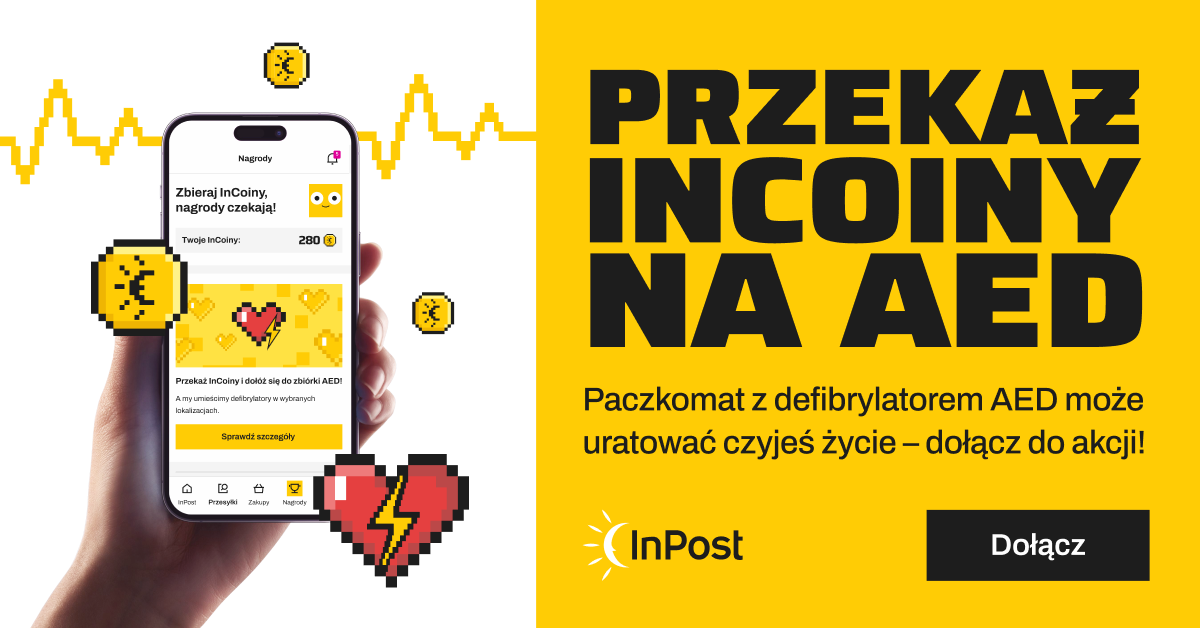
 Donate InCoins in the InPost app!
Join the initiative by InPost and Centrum Ratownictwa!
Donate your InCoins in the app to support the installation of AED defibrillators and fill in the blank spots on the map of Poland.
First aid – the sequence of life-saving actions
The universal principle of first aid should be adopted. CABC procedure . This means performing critically important life-saving procedures. The individual letters of this acronym stand for:
C (Control of bleeding) - early detection and stopping of massive bleeding. When helping a seriously injured person, massive haemorrhage should be expected. Rapid loss of a large volume of blood in a short time will lead to the death of the victim. Massive haemorrhage is considered the most common cause of death in victims, far ahead of problems with restoring and maintaining airway patency. Contemporary first aid doctrine even indicates that aggressive measures should be taken to control massive haemorrhage. Familiarise yourself with the characteristics of massive haemorrhage:
- the victim is lying in a pool of blood,
- you can see a wound from which blood is flowing profusely (it may be gushing or flowing in a continuous stream),
- the patient's clothing is soaked or dripping with blood,
- The patient underwent traumatic amputation.
The basic method of stopping bleeding is to apply strong direct pressure to the bleeding site with a dressing. For this purpose, you can use, for example, an item of clothing, a towel or a kitchen cloth. If you want to increase your effectiveness in providing first aid for massive bleeding, take part in training on the use of pressure dressings, tourniquets and wound packing.
A (Airway) - Ensure that the airways are clear. If there is no massive bleeding or it has been controlled, ensure that the airways are clear. Try to establish verbal contact with the victim. If they are talking to you normally (speaking in full sentences without difficulty), you can safely assume that their airways are clear and they are breathing. If this is not the case, you need to take action. Unconscious persons lying on their backs are at risk of airway obstruction. To prevent this, carefully tilt their head back using the "forehead-chin" manoeuvre - press down on the forehead with one hand and gently lift the chin with the other.
B (Breathing) - breathing: if you have ensured that the airways of an unconscious casualty are clear, check whether they are breathing. A good practice for checking breathing is to use three senses simultaneously:
-
I can see the movements of the chest.
-
I hear - the murmur of air above the airways,
-
I feel the warmth of the exhaled air.
Look for signs of breathing for up to 10 seconds. Two breathing cycles within 10 seconds are considered normal. If the patient is not breathing, consider this a sign of sudden cardiac arrest (SCA).
C (Circulation) - If you have determined that the victim is in cardiac arrest based on the absence of breathing, call the emergency services on 999 or 112 and begin chest compressions. If possible, obtain and use an AED defibrillator. If the victim is breathing but rapidly, is pale and sweaty, they may be in shock. Keep the victim in a lying position, try to prevent them from getting cold and check their breathing regularly until help arrives.
When administering first aid, never forget to:
- your own safety, the safety of the victim and witnesses to the incident
- notifying the emergency services (999, 112)
- CABC treatment sequence
Use an AED defibrillator if you have one available.
AED defibrillators are small devices intended for use only in life-threatening situations. They are installed in public spaces, for example at Helpbox 365 stations on Paczkomat machines They are primarily used in situations of sudden cardiac arrest, when the victim is unconscious and their breathing is fading.

It is crucial to get to the device as quickly as possible. Therefore, if you recognise the symptoms of cardiac arrest, ask witnesses to locate and bring the nearest AED defibrillator as quickly as possible. Once you have the device to hand, turn it on and follow the instructions. Using an AED defibrillator is intuitive. The device analyses the victim's heart rhythm itself and will only deliver a shock if justified. This eliminates the risk of accidental use of the AED defibrillator.
First aid – how many compressions and at what rate should they be performed?
If you do not have access to an AED and the patient is not breathing, perform CPR. cardiopulmonary resuscitation (CPR) How can this be done?
- Kneel beside the casualty.
- Place the wrist of one hand in the centre of the casualty's chest and the other wrist on top of it, then interlock your fingers.
- Lean over the casualty, keep your arms straight and perpendicular to the sternum, and press down to a depth of approximately 5–6 cm.
- Compressions should be repeated at a rate of 100–120 compressions per minute.
- If you have the equipment and skills, after performing 30 chest compressions, give two rescue breaths.
- Continue chest compressions and rescue breaths at a ratio of 30:2, or compress the chest without interruption if you are not giving rescue breaths, until:
-
arrival of the emergency medical services
-
appearance of signs of restored circulation (coughing, speech)
-
exhaustion
-
changes in the situation to dangerous
-
recommendations to stop compressions using an AED defibrillator.
Remember that using an AED defibrillator increases the chances of a successful rescue!
How to consolidate your knowledge of first aid?
To act confidently in a crisis situation, make sure you keep your first aid knowledge up to date and refreshed Both paid and free courses are available. By participating in them, you will learn to remain calm when it is necessary. If you can use an AED defibrillator, always use it.
InPost has established cooperation with the Rescue Centre to raise awareness of citizen rescue. . We install AED defibrillators on the sides of selected machines. The first two Helpbox 365 stations have already been installed in Warsaw and Krakow. At the moment, there are already several dozen of them throughout Poland, thanks to which we are filling in the gaps.
If you would like to join us in supporting citizen rescue services and improving safety in Poland, you can use the InCoins you have collected to purchase additional AED defibrillators Use your InCoins to make us all feel safer!
First aid rules – questions and answers
- Q: What is the frequency of chest compressions in CPR for young children?
A: When performing CPR on young children, it is recommended to perform 100–120 compressions per minute.
- Q: Is it safe to use an AED defibrillator?
A: Yes, AED defibrillators are designed to be easy to use, even for people without medical training. The device analyses the heart rhythm itself and delivers an electrical shock only when necessary.
- Q: Does using an AED replace CPR?
A: No, AEDs and CPR are complementary measures. Chest compressions help deliver oxygen to the victim's body, reducing the risk of tissue malnutrition.