

25 September 2023
Advertising on the Internet is currently one of the best, if not the best, way to inform customers about your products and services. The skilful development of this communication channel offers the chance of great publicity and thus profits for a company of any size. But how do you make the most of it? With our guide, creating effective online advertising will become much easier!
Online advertising - what is it?
The term 'online advertising' covers a range of marketing activities aimed at promoting the product, service or website of the company offering it. This way of reaching customers is extremely popular because it offers opportunities that are not available when advertising in other media. This is best understood by looking at the characteristics of this type of marketing message. These include:
- targeting;
- interactivity;
- timeliness;
- variety of forms of communication;
- wide-ranging impact.
Targeting
Targeting, i.e. defining a target group of customers and directing the message exclusively to them, is the greatest differentiator of online advertising. Based on the characteristics of people who may be interested in a particular product or service, specific web users are reached. In other words, in this case, the message is targeted at consumers in a particular age range, living in a particular location (e.g. a large city), with particular interests, etc.
What does targeting Internet users achieve? First and foremost, it ensures that you reach people who are likely to be genuinely interested in your ad. It also makes the investment in promotion cheaper, as it eliminates showing it to web users who almost certainly will not decide to buy the product in question. There is a simple rule here - the fewer times it is displayed, the less the advertiser will pay for the campaign.
Interactivity
Whether online advertising is effective is influenced by audience engagement. In this aspect, it is again superior to campaigns run in other types of media. As a good example, we can mention TV spots, during which many people are engaged in other activities, ignoring the message. As a result, the advertiser pays for a campaign that is less effective than he or she would expect based on the resources invested in it.
This is much more difficult with online advertising. Many forms of it, such as interactive graphics, banners and videos, require the user to click a button to turn them off. However, this is not always possible, as in many cases, the internet user can only jump to the material of interest after viewing the ad. Although most internet users find this form of communication annoying, its effectiveness cannot be denied, as the content is memorable for some time.

Update
Advertising on the website and social media offers a unique opportunity to respond to current events and consumer needs. Many companies take advantage of this opportunity by creating tailored content. The most imaginative of these are appreciated to such an extent that they become viral. Such spontaneous activity by web users carries the message further, ensuring otherwise unattainable popularity. Although it is short-lived, it can result in a spectacular increase in sales and, therefore, profits.
Variety of forms of communication
What do promotional materials published in other media have in common? Equivalence, understood as using the same form of media. In the press, there is no other option than to place a photo or graphic. On the radio, an advertisement will always be broadcast in the form of a short radio play. On television, on the other hand, one way to attract customers is to broadcast advertising spots. On the web, there are no such restrictions.
Wide-ranging impact
The various methods of online advertising offer the chance to appeal to consumers with different tastes. These range from those who are better persuaded to buy by a longer article to those who prefer short videos published on social media. This makes it easier to reach many different customer groups. Combined with the sheer popularity of the internet, advertising in this way provides the greatest reach, unquestionably winning out over other media.
The beginnings of online advertising
Product advertising on the Internet has a history almost as long as the product itself. The first ever was displayed to internet users on 27 October 1994. A black rectangle was placed on the Hot Wire magazine website with the words Click here?, inviting people to see what would happen if they clicked on it. A link implemented in the banner led to the website of the mobile phone operator AT&T. Importantly, the promotional campaign did not end with promoting this network. Part of the campaign was a competition to gain access to a virtual tour of seven of the world's most famous museums. 
At the time, advertising a company on the internet was a novelty, so many people were really intrigued. How many? Almost every second internet user. AT&T was thus a stunning success, but it is important to remember to interpret it in a specific context. Firstly, web users at the time necessarily could not have been weary of an overabundance of marketing messages, and secondly, there were few of them. Over time, the power of advertising began to decline, which was, on the one hand, a natural phenomenon and, on the other, the aftermath of bad practices by advertisers.
In the 1990s, targeting did not yet exist, making online advertising more like its TV counterpart. To get the message across, it had to stand out. For this reason, banners were colourful and, over time, also started to attract attention with sound. They also appeared more and more. In addition, the successive formats became more and more intrusive, displaying themselves suddenly and even moving to avoid being switched off by the Internet user. The effect of such campaigns was increasingly counter-productive. Advertisers therefore began to look for new, more effective and less intrusive ways of promotion.
Advertising on the web today. Types of online advertising
Banner advertising on the internet, although it still exists, is slowly becoming history. The click-through rate of such boards is now very low, to which the practices of the 1990s and the first decade of the 21st century made their negative contribution. The development of ad-blocking browser plug-ins was also a reaction to these.
However, with the rapid growth of the internet, no industry or individual business could afford to be absent from this medium any longer. The need for radical change resulted in new forms of promotion. This led to the creation or development of formats such as:
- video spots;
- sponsored articles and blog posts;
- sponsored links;
- remarketing;
- website positioning.
Video spots
Short videos presenting an offer to customers are one type of online advertising that is growing in popularity. We can encounter campaigns of this type almost everywhere - on social media platforms such as Facebook, Instagram, TikTok and YouTube, general interest portals, sites for people interested in specific issues, etc. However, this form of promotion is not always appropriate. Much more attentive advertisers than before have discovered, among other things, the effectiveness of factual texts.
Sponsored articles and blog posts
Can online shop advertising be created in the form of a video? Absolutely, it will work just as well as a promotional tool for a large and recognisable chain as it will for a small business. A small e-commerce business like no other should make use of, among other things, sponsored articles. Content of this type is created primarily with the reader in mind. The only form of promotion in this case is the link placed in the text.
The purpose of such articles is both to promote the company's offerings and to build its brand as customer-friendly. Thanks to the texts, he has the chance to find answers to his questions. The great advantage of this type of advertising is that it cannot be blocked. It is for this reason that sponsored articles are becoming increasingly popular, which they are gaining at the expense of increasingly ineffective banners. This type of advertising should be complemented by the creation of a company blog. Like texts on other sites, it will help to promote and create the company's image and position the site.
Google Ads sponsored links
Google Ads (formerly AdWords) links leading to the homepage or subpages of an online shop are extremely effective. They ensure search engine visibility as they are placed at the top of the website. Nowadays, they are increasingly functional, as Google offers the possibility to create them from among a dozen or so formats. This makes it possible, for example, to add a contact form.
Website positioning
Even the best internet advertising, which you have to pay for, will not deliver as much as painstaking work at the grassroots. Optimising a website for SEO should be done in two ways. It is necessary to take care of it from the technical side, as this determines whether Google's indexing robots will consider it worthy of recommendation to users and will start positioning it higher.
For this to be possible, the website must, above all, open quickly. Otherwise, the patience of the internet user cannot be counted on. If he does not connect to the site in a short time, he will probably close the tab in his browser. What happens if he accesses the site, but it continues to operate slowly? It is possible that conversion will be affected. The customer will abandon his virtual shopping cart and buy from a competitor.
In technical optimisation, it is also important to adapt the website to both desktop and mobile browsers. Today, the vast majority of web traffic comes from a smartphone or tablet rather than a computer. Failure to adapt the website to the screen size of mobile devices is therefore nothing less than giving up a huge group of customers.
Technical optimisation should go hand in hand with ensuring that all content on the website is prepared according to SEO principles. Search engine visibility will be improved by the use of key phrases, the creation of content for the aforementioned blog (also including such phrases) and the regular refreshing of texts by rewriting them, adding elements such as videos or graphics and updating the content.
Remarketing
Positioning as online advertising has excellent long-term effects, allowing you to promote yourself to new customers and remind old ones. The latter are particularly worth taking care of. This is because there is a good chance that something else from the company's offer will interest them in the future. On the other hand, they may also forget where they bought a product or ordered a service. This is where remarketing, i.e. sending e-mails to existing customers, comes in handy.
However, a reminder of your existence must not be limited to sending messages with current offers. A former customer will start to treat them as spam, and this is a simple way for them to cancel their subscription. Fortunately, this can be avoided, and one way is to send discount vouchers for future purchases. Instead, you can also offer to take advantage of a limited offer or enter a competition with material or monetary prizes.
 Advertise with InPost
We offer attractive advertising solutions for your business. Check out our full advertising portfolio and choose the best path forward.
Advertise right where your customers pick up their parcels!
How do you start your online marketing efforts?
Free advertising on the Internet does not exist because effort and time, and therefore money, are put into each one. For this reason, the first action to be taken is to set aside funds for a promotional campaign. Once the budget has been set, you can move on to the next steps, including the most important one, which is taking care of the technical optimisation of the website. It is best to entrust this task to specialists from an SEO agency, who will check the performance of the website and improve it.
Then you should move on to checking the content on the page and improving it so that indexing robots can find it more easily. In other words, content such as product descriptions should be unique for each item. This applies to everything in the range, so also to the same goods differing only in, for example, the colour version. In addition, the texts should include key phrases that are typed in by internet users searching for the product in question. The process of optimising the website should be completed by launching a company blog and, if there is one, improving and refreshing the articles already published.
A website is a company's business card and its most important marketing tool. By optimising both the technical and content sides of the website, it can be ranked high in search results and this will translate into a higher number of visitors. Will this have an impact on conversions? This already depends not only on promotional activities, but also on the attractiveness of the offer, prices and payment and delivery methods. Only when all these aspects are taken into account can you move on to investing in other forms of advertising. Otherwise, you are missing the point and will only end up wasting money.
How to measure the effectiveness of online advertising
Marketing on the web more or less translates into increased sales, but it costs money. This is why we suggest checking tools such as Google Analytics to see how much the effort and resources put in have paid off. For this purpose, ratios such as:
- CTR (click-through rate);
- CR (conversion rate);
- CPM (cost per thousand);
- CPC (cost per click);
- CPA (cost per action);
- Time on Site;
- Bounce Rate.
CTR
CTR is a click-through rate that allows you to see how many people were interested in a banner ad in relation to the number of impressions. If less than expected, it is important to consider what could be the reason for this. Sometimes the problem is the selection of the wrong target group, the page on which the promotional material appears or even its placement in an inconspicuous place.
CR
The abbreviation CR stands for conversion rate, which indicates how many of the internet users who visited the site bought a product. In this case, an unsatisfactory result is often due to the slow performance of the website.
It is possible that this is due to a lack of UX (user experience). A complicated interface that makes it difficult to find a product, a contact form or a FAQ (question and answer section) is sufficient motivation for a customer to leave the site and use the services of a competitor.
Low conversion may also be due to too few payment or delivery methods. If none of the above reasons are affecting sales performance, it is worth looking at what is no less important - the variety of product ranges and prices, and then comparing them with the merchandise and amounts set by market rivals.
CPM, CPC i CPA
Within this group are metrics showing cost per thousand impressions (CPM), cost per click (CPC) and cost per action (CPA). The first ratio allows you to see how much you came to pay for an advertising campaign and, consequently, how the spend translated into increased brand recognition.
The other two coefficients are used to check the extent to which the promotional campaign increased customer interest. In the case of CPC, it is the ad click itself that matters. With the CPA coefficient, you can verify not only this, but also what the user of the page did next. In other words, it lets you know how many people went to the website and placed an order after seeing the promotional material. CPA also distinguishes itself by taking into account even more actions, such as agreeing to a newsletter or filling in a contact form.
Time on Site i Bounce Rate
The advertising interest that led the user to the website also provides an opportunity to see how long they stayed on the site (Time on Site). If short, it means that there is too little engaging content on the site. It is very possible that the offer is so limited that there is no need to browse the site for longer. The problem may also be a lack of interesting content, an unattractive website design or difficult navigation. In some cases, i.e. when a website looks particularly bad, there is also an increased Bounce Rate. This term refers to a situation in which an internet user quickly leaves a website without viewing any pages. 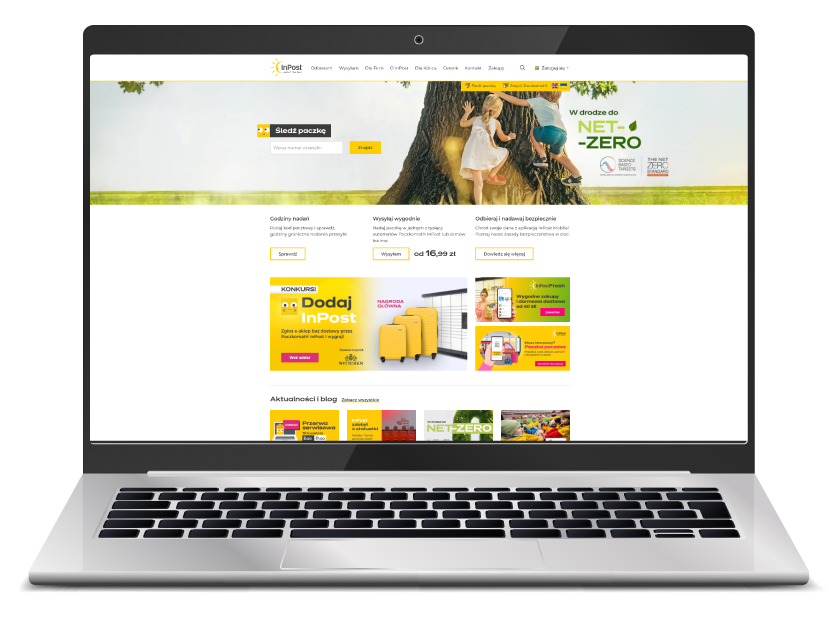
Advertising on the internet with InPost - reach hundreds of thousands of recipients
Good advertising on the Internet has great impact, but everyone lives primarily outside the virtual world. For this reason, it is not worth giving up traditional forms of promotion, albeit appearing in different places than before. This is why we offer effective ways of showing ourselves to customers. By cooperating with us, the advertiser can choose the following forms of advertising:
- Decoration of Paczkomat® machines in selected locations with your individual creation;
- Banner in static form displayed on the screens of Parcel Machines®;
- Sampling - advertising of product samples via distribution of samples in the caches of the Paczkomat® devices.
InPost's business customers are also offered the opportunity to purchase advertising space online. The offer includes such forms of promotion as:
- advertising banners on the InPost website;
- advertising entries in the InPost newsletter;
- banners and push notifications in the InPost Mobile app.
The forms of advertising cooperation with InPost can be individually tailored to the customer's needs and advertising budget. Our services are tailored to both large and small businesses. Get in touch with us - we will be happy to learn about your needs and present dedicated solutions.
Advertising your company with InPost? Always a good idea!
Take a minute to leave your contact details and we’ll prepare a tailored offer for you.
There are plenty of possibilities:
- Branding on Parcel Locker machines
- Ads displayed on Parcel Locker screens
- Sampling of promotional products
- Banner ads on the InPost website
- Advertising in the InPost newsletter
- Push notifications in the InPost Mobile app